
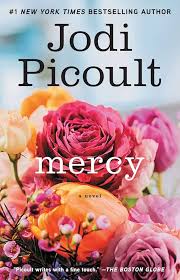
Hello beautiful people! Welcome to a new review! For this review, I dive into another Jodi Picoult book, and while Mercy definitely wasn’t one of my favourites that I have checked out, it was still a good read. Focusing on assisted dying, the various characters are forced to face what they would do for their loved ones, and if consequences are valid in those situations. Let’s get into it!
Main Characters:
Cam MacDonald: Chief of police, is forced to deal with an unlikely situation when his cousin is charged with the death of his wife, and the circumstances of the death divide people on what the outcome should be, is forced to deal with his profession and his family at the same time
Jamie MacDonald: Cam’s cousin and husband to Maggie, who requested he end her life to end the pain, now forced to deal with the consequences of his wife’s death and questions as to whether he did the right thing, or could just no longer deal with having a sick wife
Maggie MacDonald: Jamie’s wife whose request to die after being terminally ill for some time sets off the chain of events followed in the book
Allie MacDonald: Cam’s wife and a supporter of Jamie, struggles to understand her husband’s position and his rigidity when it comes to facing this situation with his cousin
My Review
I always go into a Jodi Picoult book knowing a few things. I am about to be thrown into an emotionally charged situation, and I may not agree with all the characters and how they handle this emotional situation. Mercy is very much one of those books. The topic of medically assisted death, or mercy killings, has been a large topic, especially in recent years. With a struggling economy and medical system, there becomes a question of how long we let people suffer for before essentially just speeding up the inevitable ending. It’s a topic that has good points on both the pro and con side, so it’s really hard to say how I feel about it one way or another. At its core, this novel asks one massive question: Is it ever okay to kill someone you love if they ask you to? From that point on, Picoult does what she does best: she complicates it. Morally, legally, emotionally, and relationally. No angle is left untouched, which is both the book’s biggest strength and, at times, its biggest weakness. I settled on rating the book a 6.5/10 overall. While I really enjoyed the topic of the book and the different characters and views, I found it to be kind of slower than expected. I just felt like there was a lot of filler throughout, and I just wanted to know what the court and public would decide. It wasn’t an overly exciting book, and while the added aspect of family connection helped keep you more interested, it just wasn’t enough to really help you make it through.
When Cam MacDonald, the chief of police, stumbles onto chaos, he has no idea just how much it will blow up his life. His family member Maggie is dead after suffering from her illness for a long time. But it wasn’t her illness that took her in the end; it was her husband. Only now Jamie, Cam’s cousin, has his word to corroborate that Maggie asked him to end her suffering. While it’s true Maggie was sick, no one can confirm what Jamie says she asked, and he agreed to do. Cam and his family are thrown into town gossip and chaos, and are forced to pick sides, even if it’s different from one another. The question of whether what Jamie did was moral, and if Maggie even asked him to do this, follows us as we go through the book.
The story centers on a mercy killing and the ripple effects it has on a small town, a family, and a marriage already quietly cracking at the seams. While the case itself is compelling, Mercy spends just as much time exploring marriage, resentment, fidelity, and what happens when duty and love stop aligning. Where this book really works is in its emotional realism. Picoult excels at showing how grief isn’t clean, how love can coexist with anger, and how doing “the right thing” doesn’t necessarily bring peace. The characters feel painfully human, flawed, impulsive, and often frustrating in ways that feel intentional rather than sloppy.
That said, this is not one of Picoult’s tighter novels. The pacing can feel uneven, and there are moments where the emotional introspection drags just a bit too long without moving the story forward. Some character choices are understandable on paper but exhausting to sit with, especially when the same internal conflicts circle repeatedly. I also found myself more invested in the moral question than in certain relationship arcs, which occasionally pulled focus away from what should have been the strongest parts of the book. Compared to some of Picoult’s later work, Mercy feels less polished; the ideas are there, but the execution doesn’t always hit as sharply as it could. It’s thoughtful, but not always gripping. Emotional, but not always satisfying.
Still, this is a book that lingers. Even when I wasn’t fully enjoying it, I was thinking about it. And honestly, that’s kind of Picoult’s whole thing; she doesn’t write comfort reads, she writes conversations you’re still having with yourself days later.
Mercy is a morally heavy, emotionally messy read that asks big questions without offering easy answers. While it doesn’t quite reach the impact of Picoult’s strongest novels, it still delivers thoughtful commentary on love, autonomy, and the limits of the law. A solid read, just not a standout.
*** Don’t go any further if you don’t want to read any spoilers ***
Jamie MacDonald, who openly admits to killing his terminally ill wife Maggie at her request, is found not guilty. The jury ultimately accepts that what he did was an act of mercy rather than murder, choosing compassion over a strict interpretation of the law. Legally, Jamie walks free.
But the acquittal doesn’t feel triumphant, and that’s very much the point. Jamie is left carrying the emotional weight of his choice, knowing that while the court has absolved him, the loss of Maggie and the reality of what he did will follow him for the rest of his life. The verdict brings closure to the case, but not peace.
At the same time, Cam, who prosecutes Jamie and is also his cousin, watches his own life unravel. His marriage to Allie deteriorates as the trial forces both of them to confront long-standing emotional distance, differing moral beliefs, and Cam’s infidelity. While Jamie is legally spared, Cam’s personal world collapses, underscoring Picoult’s message that justice in the courtroom doesn’t mean justice in life.
The novel closes without neat resolutions: relationships remain fractured, forgiveness is uncertain, and the emotional consequences linger. Mercy ultimately leaves readers sitting with the uncomfortable truth that sometimes there are no winners, only choices, and the aftermath of living with them.
Thank you for checking out this review. I hope you enjoyed! Feel free to subscribe to the page to be one of the first to know when I release a new review!

 Baddie Book Reviews