
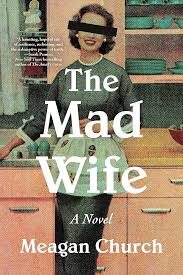
Hello beautiful people! Welcome to a new review! For this review, I delve into The Mad Wife by Meagan Church. Set in the 1950s, we follow a nuclear family tackling mental health in a restrictive world. A dynamic book full of interesting and questionable characters, we all question have the housewives wives gone mad?
Main Characters:
Lulu Mayfield: Once a farm girl running in the fields, now a picket fence wife trying to be good in everything, Lulu works hard to keep up appearances and be just as good as the rest of the wives in the neighbourhood who do everything with a smile and lipstick, underneath it all Lulu’s facade starts to crack and she questions her own stability and those around her who’s secrets run deep behind their perfect family home doors
Henry Mayfield: Lulu’s husband, who, like many of the time, works all day and then ignores their family and wives all evening, missing the struggles his wife is going through Henry starts to take the advice of others, pushing his wife to a place that he could have never imagined she would go
Bitsy Betser: Lulu and Henry’s new neighbour, who, like the other wives, seems perfect on the surface, but Lulu starts to notice strange things about her and her family, with whisperings about Bitsy’s past, Lulu is determined to find out her past, out of fear it may determine her future
Gary Betser: A typical husband of the time who presents his house and wife as perfect from the outside, but on the inside, it’s clear he has secrets to hide; his presence in the neighbourhood instills this fear in Lulu that she can’t label
Nora: Another housewife in the neighbourhood and Lulu’s closest friend, the woman to whom Lulu tries most to present herself to be; however, she also brings an eye of judgement and expectations that Lulu is uncertain she can ever live up to, representing everything Lulu is trying and seemingly failing to be
My Review
This was my first time reading one of Meagan Church’s books, and I will definitely be finding more to check out in the future. Diving into the gruelling and ugly world of women’s physical and mental health, The Mad Wife makes us all look at the world created for women, which ultimately hurts them the most. Focusing on common North American household values, the book feels very relevant as our world is currently going back to the past, rather than moving toward the future. If you love The Bell Jar or The Yellow Wallpaper, you would definitely love the mad wife. I gave it an 8/10 rating overall. I found the book and the characters to be dynamic and interesting, but the book did falter for me a bit in the second half.
Lulu Mayfield’s life has turned out not as she wanted, but as the world expected of her as a woman in the 1950s. While she loves and dotes on her husband, Henry and their son Wesley, it’s not her. Living the expected picket fence life, making her beloved Jell-O salads for neighbourhood get-togethers, and following the strict recommended cleaning schedule, Lulu feels lost. When Bitsy Bester moves into the neighbourhood, Lulu observes the strange woman to be anything but what is expected of her, but still putting on the facade that all is good in her world. Lulu’s obsession with Bitsy spirals during her pregnancy with their second child, and Lulu starts to lose herself more. As Lulu starts to lose herself, her husband denies what is going on in front of him. In this time, there is a way you deal with unstable women, and we question whether or not Lulu can save herself from her fate or lose her true self forever.
If you’ve ever wondered what it feels like to inhabit the world of a mid-century housewife, the rituals, the performative perfection, the hidden strain, The Mad Wife will pull you right into it. Meagan Church crafts a vivid, unsettling portrait of 1950s suburbia where the manicured lawns and cocktail parties conceal deeper anxieties and historical blind spots. From the moment Lulu celebrates motherhood and domestic rituals with a steel-plated smile, you sense something simmering underneath. The setting isn’t just decorative; it’s a living force that shapes behaviour, suppresses honesty, and dresses pain in pearls and cake mixes. Church makes it feel alive, the expectations, the adult-only social codes, the quiet policing of women who don’t quite fit the mould.
Where this novel truly excels is in how it explores the territory between reality and perception. Lulu’s fixation on Bitsy isn’t just suspense or paranoia; it’s symbolic. As she watches her neighbour, she’s watching herself, and every unanswered glance, every whisper in the cul-de-sac, becomes a reflection of her own fears about identity, autonomy, and what it means to be unseen. Church also weaves in poignant commentary on the treatment of women’s mental health in the 1950s. “Hysteria,” tranquillizers, whispers about “housewife syndrome”, these aren’t just plot devices. They underscore how women’s pain was too often medicalized, ignored, or pathologized instead of listened to.
The psychological texture of the story, the foggy days, the creeping uncertainty, the way ordinary events start to feel off, is reminiscent of classics like The Bell Jar, but The Mad Wife stands on its own with a more domestic, mid-century beat. The twists in the story were fantastic and really caught you off guard. What I enjoyed most about the twists in the book is that they were not fantastical or out there; they were real. It’s hard to not get into that too much without giving any spoilers, but I loved the way they were handled in the book and how they made you go “yes, that makes so much sense!”
If I have one critique, it’s pacing: the tension blossoms slowly, and some parts linger in that uneasy middle more than necessary. But that lingering is also the point; it replicates the fog in Lulu’s mind and the way real life can drift into confusion without clear edges.
The Mad Wife isn’t a thriller in the fast-paced, twist-every-chapter sense. It’s a psychological, atmospheric exploration of womanhood, identity, and the silent pressures that shape a life. It’s a slow burn, uncomfortable at times, and deeply human. That subtlety, the way it refuses to offer tidy answers, is why it sits at a higher rating for me. Impactful, thoughtful, and emotionally resonant, even if it isn’t a heart-racing page-turner. Highly recommended if you love historical fiction with emotional depth, psychological insight, and characters that stay with you.
I hope you enjoyed this review! Thank you for checking it out! Feel free to subscribe to the page to be one of the first to know when I release a new review!

 Baddie Book Reviews