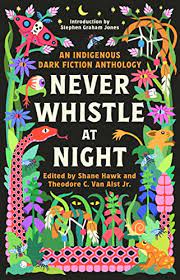
Hello Beautiful People! Welcome back to another review! For this review I get into something a little different, a collection of dark horror stories Never Whistle at Night: An Indigenous Dark Fiction Anthology is a collection of twisty, and frightening stories written by different Indigenous authors across North America. I really enjoyed getting to read so many different stories from so many different authors, so let’s get into it!
My Review
I want to start this off by quickly acknowledging I am not Indigenous. Growing up in Canada in a region with high Indigenous populations I’ve learned bits about the different communities and cultures. I am also extremely aware of the different atrocities and struggles the Indigenous communities have gone through since colonizers took over their land many years ago. The injustices that Indigenous peoples have suffered over numerous generations are apparent as it still affects people to this day. I would really encourage you if you aren’t educated on the history, to do so. A lot of the stories in this collection revolve around the different experiences that Indigenous people go through and have gone through. The history is really relevant in a book like this.
Never Whistle at Night is a spine-tingling and overall a super enjoyable read. I really enjoyed getting to read a collection of different stories because different Indigenous communities have different practices, beliefs, and histories than others do. That made each story to be really unique although collectively all Indigenous communities have gone through similar struggles as one another. I just felt like we were getting a bit of a different perspective from so many different communities. I think it’s important to acknowledge as many of the different authors do in their stories, that they learned different tales and beliefs in their communities from different family members and elders. These things deserve to be respected as for many generations white people tried to make it so these things would never be shared with the next generation. Many Indigenous people did not get the opportunity to enjoy their culture, learn from their families and elders, and hear stories. It’s a privilege to learn about the culture and the community as a non-member and should be respected.
A lot of these stories gave us a very raw look into the different things affecting Indigenous communities such as colonization, racism, poverty, and addiction, but did it in a very artistic way. I enjoyed seeing how each author represented their culture and people, and how they spread a message without directly saying it. The social commentary is woven seamlessly into the stories, and it shows that a lot of Indigenous art is based on personal experience. Maybe not directly with the scary stuff (although I wouldn’t doubt it) but with the other horrifying things that harm people every day. The other thing I enjoyed in this book was I got to get some new Indigenous writers and their work onto my to-read list. I’ll be honest the only author I recognized in this book was Stephen Graham Jones who only wrote the forward, not even a story for the book. I’ve really enjoyed the work from Stephen Graham Jones I’ve read in the past, and it was my enjoyment of his work that actually got this book recommended to me in the first place. Overall I gave Never Whistle at Night a 9/10 rating.
I am going to share a few of my favourite stories from the collection, but I have to say I honestly did enjoy them all. They were all so different but worked so perfectly with one another in the collection. I think anyone can really enjoy this book, and I would say while it was definitely frightening, it wasn’t very gory. A few stories in the book definitely were but a lot of them weren’t very gory and used different wordplay to describe the horror going on. I think everyone can find at least a few stories that they enjoy in the collection, so I would really recommend checking it out, especially if you are a unique horror fan. I will say that’s one of the things I enjoy about Indigenous horror books, they are so unique in the different topics and things they focus on.
The second story in the book White Hills by Rebecca Roanhorse was one of my favourites in the book. It follows a young woman named Marissa who has married into a lifestyle that is very different than the one she grew up in. The book focuses on white fragility, and how white culture feels threatened by other cultures, even when there is no real threat. It was just so raw, and I felt like there was an underlying tone about colonization in it. When white colonizers took over Indigenous land they attempted to take away the culture of Indigenous people and mold them into a Eurocentric people. Even when this happened white people still did not accept Indigenous people into their communities, and would continue to push them to the side. This book focuses very much on the topic that no matter how ‘white’ you try to make yourself, white communities will still never accept you because they don’t actually want to ever accept or incorporate Indigenous people into their community. It also brought to light how white cultures feel about Indigenous people. White communities for generations have been abusing Indigenous people in all institutions and organizations, making decisions for them that they don’t consent to. It’s still happens to this day.
The Ones Who Killed Us by Brandon Hobson was another one I enjoyed in which missing and murdered Indigenous women are the main focus. Since the time of colonization, Indigenous women have gone missing, and been murdered, in frightening amounts. It’s still a major issue to this day. I thought it was a really interesting way to focus on the topic. I also really enjoyed the ending to this one and found it to be very satisfying.
Behind Colin’s Eyes by Shane Hawk was a spooky one that definitely gave me goosebumps. Anything to do with the woods has always freaked me out, and the woods tend to be a common setting for Indigenous stories. In this story father and son go hunting in the woods, and what they find defiantly isn’t what they went looking for. I just enjoyed getting to see this father-son interaction, with this dark underlying tone to it. The father is doing his best to put his son on a good path but struggles. The son also is trying to impress his dad and have him be proud but puts too much pressure on himself.
Human Eaters by Royce K. Young Wolf was another one of my favourites and was super interesting. This story focuses on a woman sharing knowledge with two teenagers. The knowledge she shares isn’t easy, and it’s a test for the boys to see what they can handle. I’ve always enjoyed the aspect of Indigenous culture which is knowledge being shared orally, and in a story like this, we see why practices like that are so important to the culture. I think it was interesting because we see in the story that when one of the teenagers doesn’t respect the knowledge being shared with him, and the one doing it, good things won’t come his way. It’s interesting to have a horror story spun into a practice like this in which the older people in the community try to teach and share with the next generation. This was another woods-based story so it definitely got my skin crawling a bit. I enjoyed this story though too because it shows the strength of the youth, and how they are important to keeping different cultures and communities alive.
The Prepper by Morgan Talty was really enjoyable because it focused on mental illness, and how it affects Indigenous communities. While yes as you can assume from the title it focuses on someone prepping for the end of the world, it’s not exactly the prepping that makes him mentally ill, it’s the degree he takes it to. While most people don’t show their mental illness in this way, I enjoyed what it showed overall. Indigenous people and their mental health are not a priority for health services. Most Indigenous people with mental illness will not be handled properly, or fairly by those in the medical profession. The answer is just generally to lock them up and throw away the key.
Sundays by David Heska Wanbli Weiden was a heartbreaker. During the times of colonization, many Indigenous children were torn from their families, homes, and communities, to be placed into residential schools. These schools were houses of horror on their own, and the children there would be severely abused emotionally, physically, mentally, spiritually, and sexually. This book focuses on the atrocities committed in residential school systems, and it affects people even for generations after. This one definitely made me sad, but the scariest part about it was how real it is. Things like this were actually happening to kids, it’s just that the specific character in the book isn’t real, but the events sure are. It was interesting getting to see something so horrible be spun into a story this way.
Limbs by Waubgeshig Rice made my skin crawl. It was a perfect story to have at the end of the book. This one was definitely one of the more gorier stories in the book, but it was powerful for sure. This one focuses on how white people have viewed/continue to view Indigenous people. It’s been long-standing that white people have abused Indigenous people for their resources and knowledge. Trying to navigate a land so vast, colonizers would often rely on Indigenous people to help them find their way, and keep them alive in the winter. Once they are done with them they toss them to the wind, with no respect or consideration for all they provided. Indigenous people’s kindness has always been taken advantage of, and this story definitely represents that. It was definitely an ending to this collection that would leave you thinking.
This is definitely a collection of stories that everyone can enjoy. You don’t have to have much knowledge or understanding of Indigenous culture to enjoy this collection, and if anything you may learn something new from it, or it may spark a new interest. I encourage people to dive into different books that focus on different cultures and community experiences. Even though all of these stories are fiction there is a lot of truth in them, and it’s a very influential collection. I enjoyed getting to read about things negatively affecting Indigenous communities in this artistic way. I think it’s just one of the ways we can connect to injustices through art, and it’s important to hear other’s stories and to give respect to those willing to share.
I hope you enjoyed this review! Have you checked out Never Whistle at Night or any other Indigenous horror stories? What did you think?
Feel free to follow me on my socials @baddiebookreviews to be kept up to date for when I drop a new review!

 Baddie Book Reviews
Thanks for the review, I’ve just put this book on order and can’t wait to read it
LikeLiked by 1 person
Thank you I hope you enjoy it’s a great read!
LikeLike