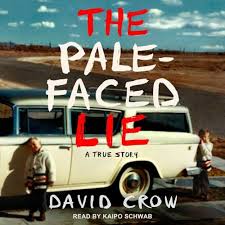
Hello Beautiful People! Welcome to a new review! For this review I get into a memoir by David Crow called The Pale-Faced Lie. The book follows David and his siblings from their childhood up to adulthood, giving David’s recollections of growing up on the Navajo Reservation in a volatile household with his unstable parents. The book is incredibly well-written and enjoyable from start to end, so let’s get into it!
Main people in the book:
- David Crow: The narrator and storyteller who gives us his perspective of growing up as the eldest boy in a household that put him in terrible situations, along with growing up in an area he didn’t fit into, David’s life was filled with turmoil in and out of the home
- Lonnie, Sam, and Sally: David’s siblings are the only other ones who experienced exactly what he did, however with David being the eldest boy his parents would often put him in situations that they would not put his siblings into
- Thurston Crow: Father to the four kids, raised his children on jaded principles built by possibly his own mental illness, or the environment that he grew up in himself, would inappropriately punish his children and treat them as though they were adults when they were not, was an ill unstable man who did a lot of things to keep up an image of someone he was not
- Thelma Lou Crow: The children’s mother, like their father, would often put the children in inappropriate situations as though they weren’t kids, was riddled with different mental health issues and was often unwilling to look at herself as having problems and not others
- Mona: The children’s stepmother who married Thurston after his divorce from Thelma Lou, treated the children inappropriately for being an adult whom they did not know, essentially attempted to force the children to see her as a mother which pushed them away from ever having a real relationship with her
My Review
I can’t totally remember how I came across The Pale-Faced Lie by David Crow but I am definitely glad I did. I don’t want to retell too much of David’s story in this review, but I definitely recommend checking this one out if you enjoy a good memoir. While there are aspects of drama and crime in this book I wouldn’t really say that it was the main focus of the story. It mostly revolves around his hectic home life and how mental illness rattled the walls within his family causing him and his siblings to experience things that no child should go through. Often being used as middlemen and therapists for their parents, David and his siblings were forced to mature far beyond their years, while also managing to find some small bits of fun and joy with one another along the way. Being instilled with toxic morals and values by parents who had tainted versions of their own, David essentially explains how he and his siblings managed to be the opposite of what was set up for them in life.
I gave The Pale-Faced Lie an 8.5/10 rating. I found an aspect that I really enjoyed about the book is that it’s very average. Don’t get me wrong there are definitely some things in David’s life that happen that not very many people experience at his age, but the way that he presents his life is just very normal. Like most of us as children, we aren’t exactly oblivious to the issues our parents have, and often (especially when he was younger) David was just on the sidelines watching the issues happen around him with no control over how things would go or end. I think there was just comfort in the way that David explained his life. Often feeling like home wasn’t a safe place, he struggled further to find somewhere to fit in on the outside. When it would feel like maybe something good was going to start for him, things outside of his control would flip how things were going often shattering the bit of confidence he had started to build up for himself.
I felt as though the relationship between David and his siblings was a real shining light in this book, and showed their ability to persevere in dark situations. While it was partly a representation of what was going on in the household there were times that David and Sam would go off together getting into trouble and just having fun. Often they would be doing some pretty bad things which David doesn’t shy away from admitting (using cherry bombs on people, rolling a tire into traffic, dangerous things but nothing that ever really hurt anyone) but to give the guys credit they learned to do these things from their dad. It was just sweet getting to David and his siblings finding joy in the little things and in one another despite how traumatic their household is. As mentioned before David’s father was the main reason for his children finding fun in destruction. The man lives and thrives on it, his entire life was it. Without giving too much away the way that David explains it is that his Dad raised his family as Cherokee but despite this being what they were raised as the family never really fit in well on Reservations. This also becomes a main focus in the book in which the Crow children are raised with disgruntled identities never really fitting into any particular area. They didn’t fit in on Indigenous spaces, but due to their time in these spaces didn’t fit into white ones either. Growing up in the 1960s having such an unclear idea of who they were created a lot of internal issues for the children meaning that they struggled to find community and areas that accepted them.
Another main topic which I felt was dealt with really well in this book was the topic of mental health. Given the time frame, in which David and his family grew up mental health was an even more taboo topic than it is today. While defiantly we have progressed in the areas of understanding it, we often aren’t focusing on the topic of mental health and poverty in succession and how this means that a large chunk of the population is not receiving any form of services for their illness, especially people who lived on Reservations. This social factor directly affects David’s family, meaning that his mother really never receives the help or diagnosis that she needs so she can’t take care of her family, and his father gets to continue living in a delusional world built by his own imagination. It was also really interesting getting to see David’s perspective of living on a reservation as a child. Living around constant mental illness, poverty, addictions, and crime, it’s a unique perspective that builds a picture as to why so many Indigenous people and their communities are suffering. Being on plots of land with no resources, no job opportunities, and to say it bluntly really nothing to live for, created a dangerous concoction on the different areas he would live in meaning he was often surrounded by the attitude that you live to suffer.
Getting to see how he and his siblings progressed as adults was also a highlight in the book, but also showed that despite the good that they would try to do for themselves they would often be pushed back to the lifestyle or where they came from. It would take a lot of control and personal reflection for them to turn the other cheek, and honestly just getting to see their growth into adults was really heart-warming.
If you love a good memoir I would definitely recommend checking this one out. The raw and real way that David tells the story of his and his family’s lives is definitely one worth checking out. The Pale-Faced Lie focuses on topics that most families experience in some form, and give voice to the issues that affect children growing up, and how that affects them as adults. While David and his siblings turned out alright despite everything they had to do a lot of fighting to get there, and had to accept and move on from a lot of things to move on with their lives.
Have you read The Pale-Faced Lie by David Crow before? What did you think?
Feel free to check out my socials @baddiebookreviews to be kept up to date for when I release a new review.

 Baddie Book Reviews